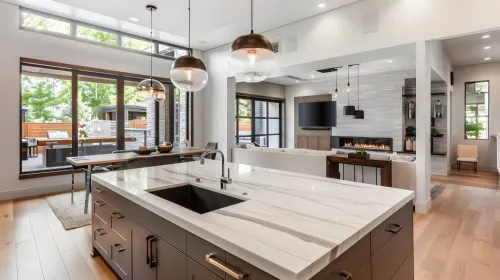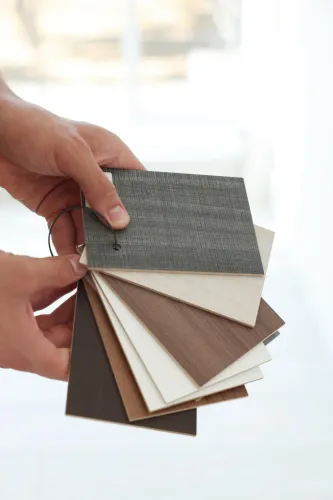
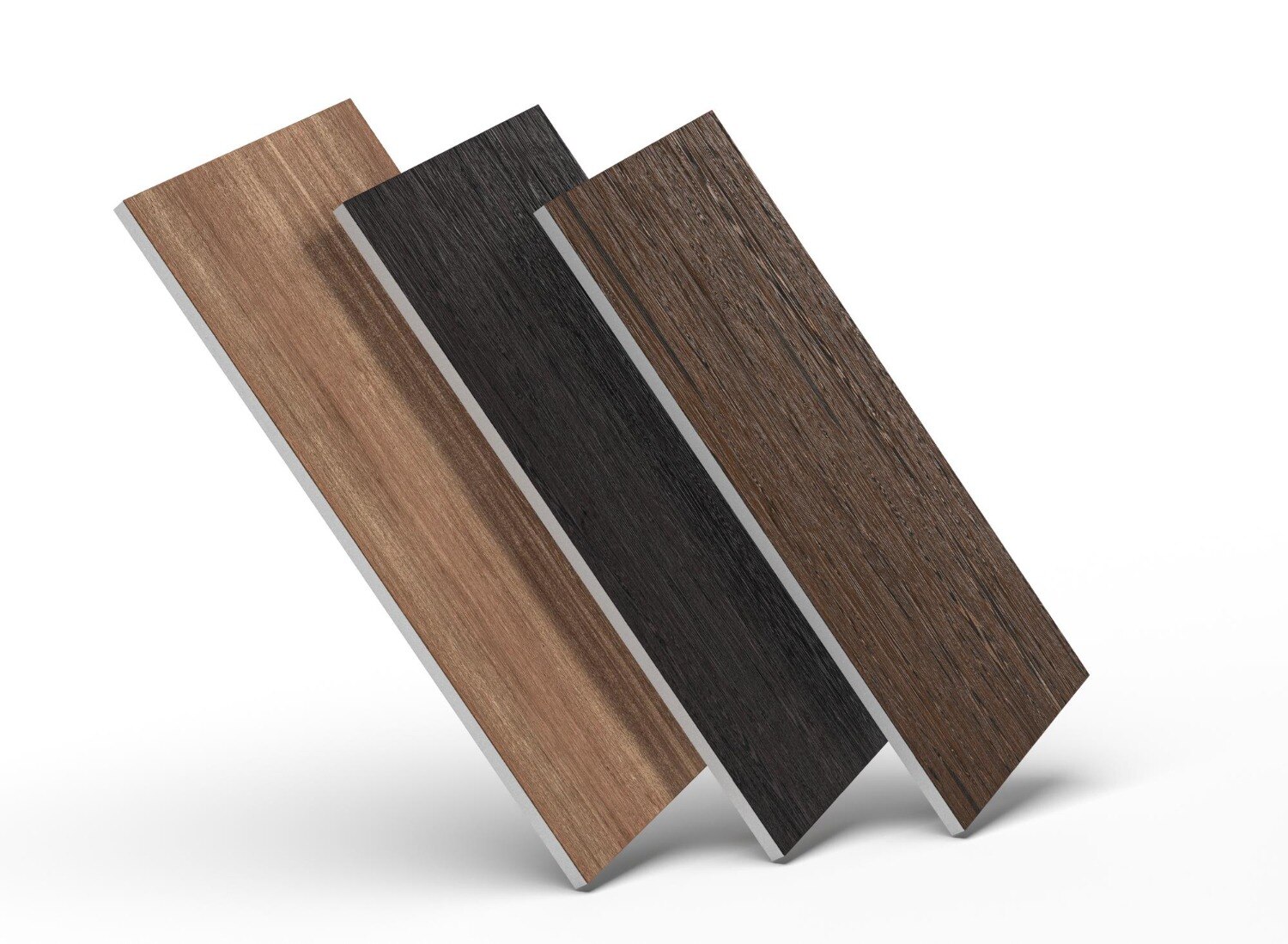
A commercial HPL surface is not usually a self-supporting panel: it is a decorative, wear-resistant sheet bonded to plywood, MDF, particleboard or another engineered substrate. By the end, you will be able to match HPL grades and constructions to specific commercial areas, read performance data, and avoid failures caused by moisture, unsuitable edges, poor balancing or incorrect installation.
Key takeaways
- Use HPL as a finish layer bonded to plywood, MDF or particleboard.
- Match the laminate specification to impact, abrasion, moisture and heat exposure.
- Check data-sheet thickness, grade, substrate and approved installation method.
- Seal vulnerable edges and verify cleaning, fire and colour-retention claims.
What HPL Is After It Becomes Part of a Commercial Surface
In a finished commercial surface, HPL is a hard decorative sheet bonded to a stable substrate such as plywood, MDF or particleboard. Standard thin HPL is a finish layer, not a self-supporting worktop, door or partition; the substrate supplies the thickness and stiffness.
The HPL laminate structure is built under heat and pressure. Resin-impregnated kraft-paper core gives the sheet body, a printed decorative paper provides the colour or pattern, and a transparent wear-resistant overlay protects the image. A balancing layer on the reverse can help control curl after bonding.
| Product | Finished form | Main difference |
|---|---|---|
| Standard-pressure laminate | Thin sheet bonded to a board | A general-purpose HPL finish requiring a substrate |
| HPL | Pressed decorative laminate sheet | High-pressure construction with separate core, design and overlay layers |
| Compact laminate | Solid, thick laminate panel | Multiple kraft layers provide its own stiffness; no board substrate is normally needed |
| Melamine-faced board | Resin-treated papers pressed directly onto particleboard or MDF | The facing and panel are made together, rather than bonding a separate HPL sheet |
A melamine-faced panel is not interchangeable with post-bonded HPL. Its exposed edges, repair options and impact performance depend heavily on the manufactured board and edge treatment.
HPL’s face resists everyday wear, but that does not make the installation waterproof. Water can still enter through cut edges, joints and screw holes, then swell an unsuitable substrate beneath the intact surface.
Match the Laminate to the Area and Its Main Stress
Choose the construction for the dominant stress, not for colour or thickness alone. Wall panels face knocks and cleaning; reception desks face edge impact and abrasion; worktops and countertops face repeated contact, spills and localized impact.
| Application | Suitable HPL construction | Properties and details to prioritise |
|---|---|---|
| Wall panels | Thin general-purpose HPL bonded to MDF, plywood or particleboard | Abrasion and stain resistance, cleanable texture, protected corners, and a tested fire classification for the complete wall assembly |
| Reception desks | Postforming HPL or compact HPL at exposed edges | Impact-resistant, radiused or replaceable edges; confirm abrasion, stain and scratch performance |
| Worktops and countertops | Horizontal-grade HPL on a stable substrate; compact HPL where the panel must carry its own stiffness | Higher resistance to wear, impact, moisture at joints and heat from ordinary service; detail the front edge carefully |
| Cabinet fronts, doors and tables | General-purpose HPL, with postforming where a seamless rounded edge is needed | Resistance to repeated opening, hand contact, cleaning chemicals and edge chipping |
| Toilet cubicles and lift interiors | Compact HPL | Moisture resistance, impact resistance, solid-colour or protected edges, and cleanable surfaces |
EN 438 distinguishes general-purpose, postforming and compact laminates. A wall-facing grade is not automatically suitable for a heavily used counter or stair component.
Scratch, abrasion, impact and stain resistance are separate claims. Matte texture can conceal marks better than gloss, but it does not prove a higher wear class.
Specify fire performance for the proposed assembly, including substrate, adhesive, joints and air gaps. A thin sheet is not self-supporting; large one-sided panels also need a balancing sheet or engineered backer to prevent bowing.
Build an HPL Specification from the Data Sheet
A commercial approval should begin with the data sheet, not the colour sample: confirm the intended use, construction and test evidence for the exact product. A thin HPL sheet needs a stable MDF, particleboard or plywood substrate; choose compact HPL when the laminate itself must provide panel stiffness.
Request these details before signing off:
- NEMA classification and EN 438 classification, including application category and whether the sheet is horizontal-grade HPL, vertical-grade HPL, postforming or compact HPL.
- Nominal thickness, sheet dimensions, surface finish, wear or abrasion result, impact resistance, scratch resistance and stain resistance. Match the ratings to counters, desks, doors, wall panels or cubicles rather than accepting “heavy duty.”
- For postforming, the permitted inside radius, bending direction, heating method and temperature window. Forcing a flat-grade sheet around a tight corner can whiten, crack or delaminate it.
- Substrate, adhesive, balancing requirement, joint detail and edge treatment. The HPL datasheet alone does not prove the performance of the finished assembly.
- Fire classification or a test report for the proposed assembly, naming the substrate, adhesive, thickness, air gap, joints and mounting method. A sheet rating does not automatically transfer to a wall, door or partition.
| Check | What it tells you | Approval decision |
|---|---|---|
| NEMA classification | North American performance and use category | Confirm it covers the stated duty |
| EN 438 classification | European performance and application category | Confirm the grade matches the exposure |
| Fire report | Result for the complete build-up | Reject sheet-only claims |
V K Sanghvi can help you compare manufacturer datasheets, but the specification should name the approved grade, thickness, substrate and assembly—not merely a colour or brand.
Related product
 | laminates ₹1780 Merino High-Pressure Laminates are made of absorbent kraft paper impregnated with melamine and phenolic resins as well as specially chosen decorative... View product → |
Prevent Moisture, Edge and Installation Failures
A decorative face does not make a conventional HPL installation waterproof. Water entering an unsealed cut edge, joint or screw penetration can swell the board beneath it, and replacing the laminate will not repair that damage.
- Confirm HPL substrate compatibility with the board manufacturer, including moisture exposure, flatness, density and movement limits.
- Use a stable, dry substrate and bond the sheet with the adhesive system specified for that substrate. Follow its open time, pressure and curing requirements; trapped air or inadequate pressure creates hollow spots and lifting.
- Apply a balancing sheet to the reverse face of a panel when the construction requires it. An unbalanced panel can bow as the bonded layers respond differently to temperature and humidity.
- Seal exposed cut edges, service penetrations and joints with the specified edge sealer. Give wet-area worktops a positive drip edge and slope water towards drainage rather than into a seam.
Treat edges as impact zones, not decoration. Use a postforming grade only where the approved radius, temperature and forming method match the data sheet; forcing a standard grade around a tight corner will crack the surface or release the bond.
Radiused edges, solid edge bands and replaceable impact trims protect busy counters and doors better than sharp exposed corners.
For toilet cubicles, lockers and washroom partitions, compact HPL removes the vulnerable board core and separate decorative skin. It reduces substrate-related failure but costs more and demands accurate machining, sealed joints and suitable fixing details. Do not substitute thin HPL for a self-supporting panel.
Check Cleaning, Fire Claims and Long-Term Appearance
Approve a commercial HPL finish against the maintenance plan and the assembled detail, not a colour chip alone. Request the data sheet for abrasion resistance, impact resistance and stain resistance; these tests address different failure modes.
A matte or textured face can disguise incidental scratches better than gloss, but it is not a higher wear class and its texture may trap soil.
Use this checklist before sign-off:
- Obtain the manufacturer’s cleaning schedule, including permitted detergent and disinfectant concentrations, contact times and tools. Exclude abrasive powders, concentrated acids or alkalis, solvents and unapproved heat; prolonged exposure can dull or stain the face.
- Ask for a sample cleaned with the proposed chemicals and inspect it at the intended lighting angle. Compare colour, gloss and texture across sheets from the same production batch, especially for doors, lift interiors and adjoining panels.
- Treat an antibacterial claim as a test result, not sterilisation. Check that ISO 22196 applies to the exact treated product, then retain routine cleaning and hygienic joints.
- For a specified fire rating, obtain the test or classification report for the complete wall, door, partition or furniture assembly. Confirm that laminate thickness, adhesive, substrate, air gaps and joints match the proposed build.
- Protect exposed edges with a radius, edge band, compact core, postformed detail or replaceable impact trim. Sharp edges chip first, and moisture entering a cut edge can swell the substrate.
A mock-up reveals cleaning effort and visual inconsistency before installation. Record the approved finish, batch reference and repair method so replacements do not create a patchwork.
Frequently asked questions
What does HPL do after it becomes part of a commercial surface?
HPL provides the hard decorative finish, while plywood, MDF or particleboard supplies the surface’s thickness and stiffness. Standard thin HPL is not self-supporting.
How do you choose HPL for a high-traffic area?
Match the laminate to the area’s main stress, including impact, abrasion, moisture or heat, then compare the product data sheet with the intended use.
What should an HPL specification include?
Record the laminate thickness, grade, substrate, surface requirements and approved bonding or installation method from the product data sheet.
How can HPL installation failures be prevented?
Control moisture, use a stable substrate, protect exposed edges and follow the manufacturer’s specified installation method.
What should you check beyond HPL appearance?
Confirm the manufacturer’s cleaning instructions and review specific fire, chemical-resistance and long-term appearance claims rather than relying on general descriptions.