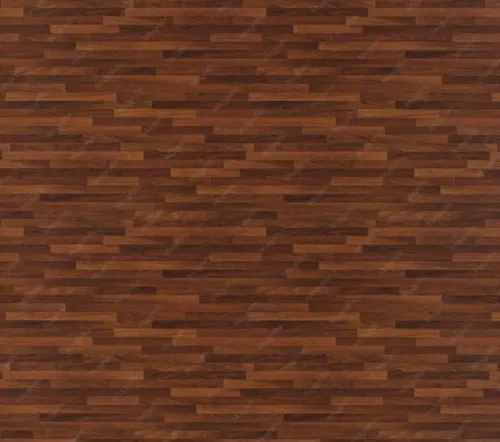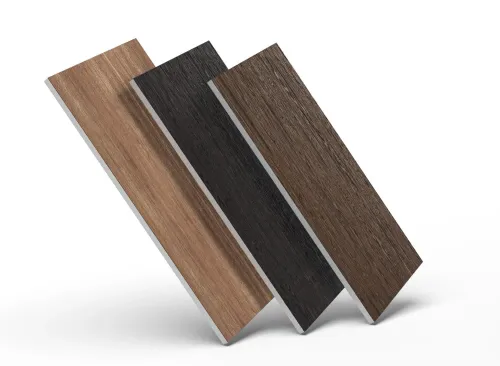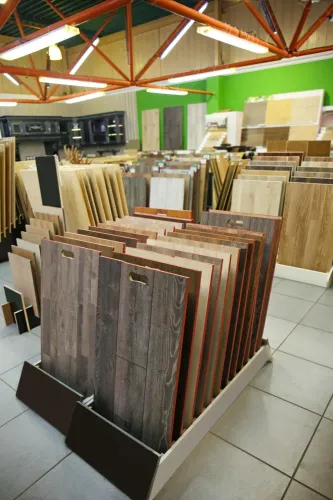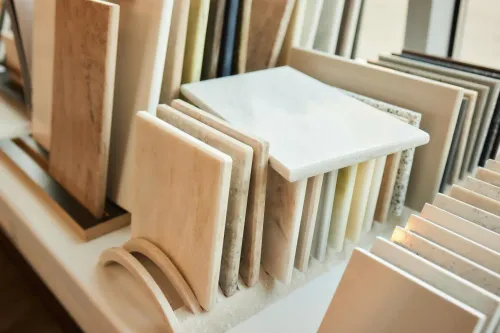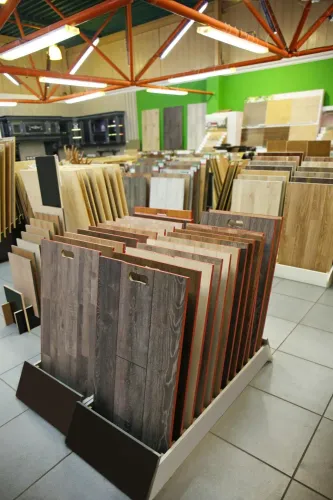
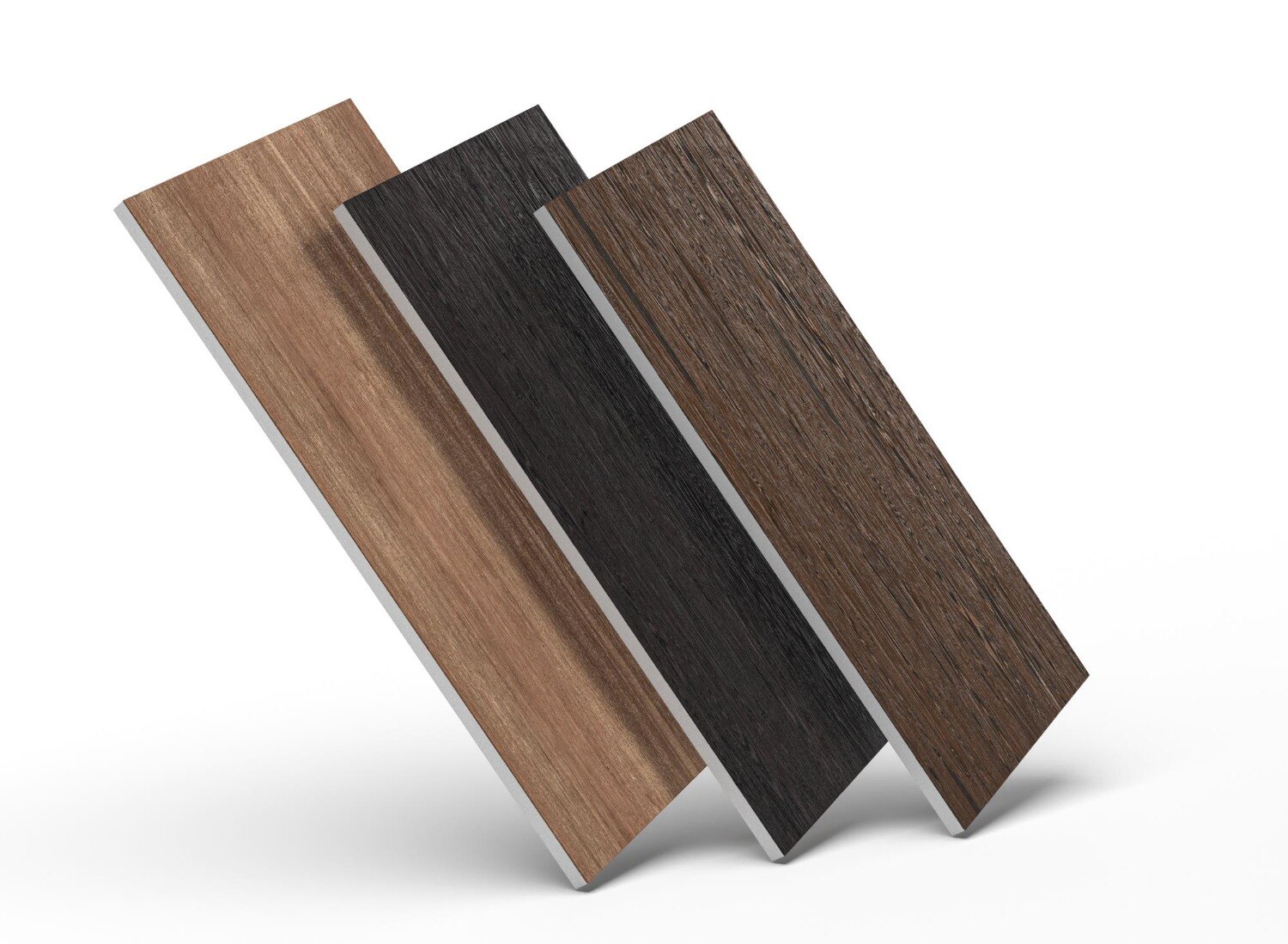
A catalogue image cannot show how a laminate reflects task lighting, collects fingerprints or feels under your hand. By comparing physical samples, complete boards, edges and material combinations with a dealer, you can choose a finish that suits both the design palette and the demands of the room.
Key takeaways
- Separate printed patterns from physical textures and surface finishes.
- Inspect full-size physical samples in your room’s lighting.
- Match laminate finish, substrate and edge treatment before ordering.
- Ask for stock, batch, thickness and care details from the dealer.
What the Main Laminate Texture and Finish Categories Actually Show
A woodgrain laminate can look like oak, feel slightly ridged, and appear matte; those are three different decisions. A visual pattern is the image printed on the sheet, a texture is the physical relief you can feel, and a finish is the surface’s sheen and touch.
| Category | What it shows | What to check |
|---|---|---|
| Visual pattern | Wood, stone, fabric, marble, solid colour or metal imagery | Grain scale, repeat, colour variation and pattern direction |
| Tactile texture | Embossed grain, brushed lines, fluting or a fabric-like surface | Texture depth, cleaning effort, fingerprints and whether relief aligns with the print |
| Surface finish | High gloss, gloss, matte, super-matte, suede, silk or soft-touch | Reflection, tactile smoothness and colour change under different light |
A stone finish may show veining without containing real stone. An embossed wood pattern should follow the printed grain; misalignment makes the sheet look artificial. Directional woodgrain, linear, fluted-look and stone designs also need consistent cutting, or rotated panels will mismatch and create extra waste.
Finish names are not universal. “Matte” or “soft-touch” can describe different surface constructions between decorative laminates brands, so compare physical samples rather than labels. View them in daylight, warm artificial light and task lighting; dark, metallic and pearlescent sheets can change noticeably with angle.
For kitchens and reception desks, compare glare, fingerprints and cleaning effort. For wardrobes, wall panels and furniture, compare tactile comfort and grain direction. If you are reviewing fabric texture laminate brands for interiors in Pune, ask to see full-size samples, not only catalogue images.
Why Physical Samples Matter More Than Catalogue Images
Approve a finish only after comparing physical laminate finish samples beside the actual flooring, paint, hardware and adjacent surfaces. Catalogue images flatten texture and distort colour; screens also hide gloss variation, edge waviness and reflections.
| Viewing condition | Compare | What it reveals |
|---|---|---|
| Daylight comparison | Colour, grain direction and undertone | Whether the laminate looks too grey, yellow, red or dark beside the room’s materials |
| Warm artificial light | Colour and gloss at evening viewing hours | Whether beige turns muddy or dark surfaces lose visual depth |
| Task lighting for interiors | Reflections, fingerprints and texture shadows | Whether glare distracts from a worktop, reception desk or wardrobe |
| Raking light from the side | Embossing, scratches and edge irregularities | Whether the surface construction looks consistent across the sample |
Hold each sample at normal viewing distance, then view it from an angle. A high-gloss or very dark laminate can reveal fingerprints, fine scratches and substrate ripples that disappear under flat showroom light.
Run your finger across the surface. Confirm that embossed grain follows the printed wood or stone pattern; a misaligned texture makes a realistic design look artificial. Compare the sample’s edge treatment and joint visibility with the proposed plywood or acrylic, because a render rarely shows those transitions accurately.
For a long cabinet or wall-panel run, approve a control sample or production batch before fabrication. Do not mix lots on one visible elevation: colour, gloss and texture can shift between batches. Record the approved sample code, finish, direction and batch number with the order.
How to Build a Coordinated Palette for Each Room
Keep one dominant finish, one supporting finish and one accent in each room; then repeat their tones across flooring, paint, hardware and upholstery. This gives you varied interior design options without turning the palette into a collection of unrelated samples.
1. Start with the least changeable surface, usually flooring or a stone worktop. Match laminate combinations to its undertone—warm oak with beige flooring, or cool grey laminate with blue-grey flooring—rather than matching colours exactly.
2. Choose the main laminate for the largest furniture area. Use matte or textured kitchen laminates where fingerprints, glare and daily cleaning matter; reserve high-gloss or very dark faces for smaller accents because they expose scratches, edge waviness and substrate defects.
3. Set the wall paint two or three tones away from the laminate. Check both together in daylight, warm artificial light and task lighting. A printed image or 3D render will not show reflections, edge thickness or how a grain changes at an angle.
4. Treat hardware as the controlled contrast. Brushed brass, black, chrome or aluminium should repeat at least twice, such as on handles and lighting, instead of appearing as a single isolated detail.
5. Add upholstery to soften hard surfaces, repeating either the laminate undertone or hardware colour. For wardrobe laminates for interiors in Pune, compare the sample beside curtains, flooring and handles at normal viewing distance.
6. Approve the edge treatment, plywood core, joints and transitions to adjacent acrylic or plywood before ordering. A coordinated face can still look wrong when the edge line, substrate telegraphing or handle clearance is visible.
How Finish, Substrate and Edge Details Change the Final Result
The final result depends on more than the chosen colour: specify the surface construction, laminate thickness, substrate, edge treatment and joint details before fabrication. Finish names vary between manufacturers, so compare physical samples under daylight, warm artificial light and raking light.
| Specification | What to check | Why it changes the result |
|---|---|---|
| High-gloss vs matte laminate | Reflection, fingerprints, scratch visibility and edge waviness | High gloss exposes surface defects and glare; matte conceals minor marks better |
| Super-matte surfaces | Soft-touch coating, cleaning instructions and resistance to burnishing | Frequent rubbing can create shiny patches if the coating is unsuitable |
| Laminate thickness | Sheet thickness and whether the design needs a matching build-up | A thin sheet on an uneven panel telegraphs bumps; extra thickness affects edge and hardware clearances |
| Plywood substrate for laminate furniture | Flatness, moisture content, screw holding and panel stability | A warped or damp substrate can cause bubbles, open joints or delamination |
| Edge detail | PVC or acrylic edging, laminate return, radius and corner finish | A mismatched edge makes a good face look unfinished and exposes vulnerable corners |
Use HPL as a bonded surfacing layer over flat plywood, MDF or particleboard; it is not structural. Choose compact laminate when the panel itself must be self-supporting. Confirm grain direction, pattern alignment, joint position and clearance around handles before cutting.
Dark gloss and metallic faces need tighter matching allowances because reflected light makes small differences obvious. A quotation should separate sheet cost from wastage, adhesive, edging, machining, transport, fabrication and installation.
What to Ask a Decorative Laminates Dealer Before You Order
A low sheet price can become the expensive option after mismatched batches, unusable offcuts and extra edge work. Ask decorative laminates dealers to price the finished installation, not just the laminate sheet.
1. “Can you reserve one production batch for this elevation?” Approve a control sample showing colour, gloss and texture before fabrication. Do not mix lots across a continuous run; small differences become obvious under task lighting.
2. “Does this product support directional cutting?” Woodgrain, linear, fluted-look and directional stone patterns may need every panel cut in one orientation. Request a cutting layout showing sheet count, grain direction and expected offcuts.
3. “Is this the correct grade for the edge detail?” For a postforming laminate grade Pune fabricators can bend, verify the technical sheet’s thickness, backing, heat window and minimum radius. Bending a flat-lay grade can cause whitening, cracks or delamination.
4. “What preparation and storage conditions apply?” Confirm acclimatisation, board moisture, adhesive type and bonding temperature. Damp, cold or warped substrates increase bubbles, open joints, edge lifting and later warping.
5. “What is the installed total?” Require separate figures for substrate, laminate, matching or directional-cutting allowance, edging, adhesive, machining, transport, fabrication and installation. A laminate supplier comparison based only on sheet price hides the real cost.
V K Sanghvi can make that comparison more useful by checking available batches and matching the selected surface to the fabricator’s edge and installation method. Get every allowance in writing before you release the order.
Related products
 | laminates ₹1780 Merino High-Pressure Laminates are made of absorbent kraft paper impregnated with melamine and phenolic resins as well as specially chosen decorative... View product → |
 | laminates ₹5300 Welcome to Luvih – where opulence meets style. Explore Super Matte surfaces, an ode to timeless elegance. View product → |
Frequently asked questions
What is the difference between a laminate pattern, texture and finish?
A pattern is the printed image, such as oak or stone. A texture is the physical relief you can feel. A finish describes the surface sheen and touch, such as matte, gloss or soft touch.
Why should you inspect physical laminate samples?
Catalogue images can distort colour, sheen and texture. Physical samples let you check the surface in your lighting, compare it with flooring and paint, and judge fingerprints or reflections.
How do you create a coordinated laminate palette for a room?
Choose a dominant surface, a supporting surface and an accent. Compare undertones, visual scale and sheen, then test the combination beside the room’s floor, wall colour, hardware and lighting.
What should you ask a decorative laminates dealer before ordering?
Ask for the exact finish, sheet thickness, dimensions, available stock, batch details, care instructions, matching edge options and the substrate or adhesive recommended for your application.